
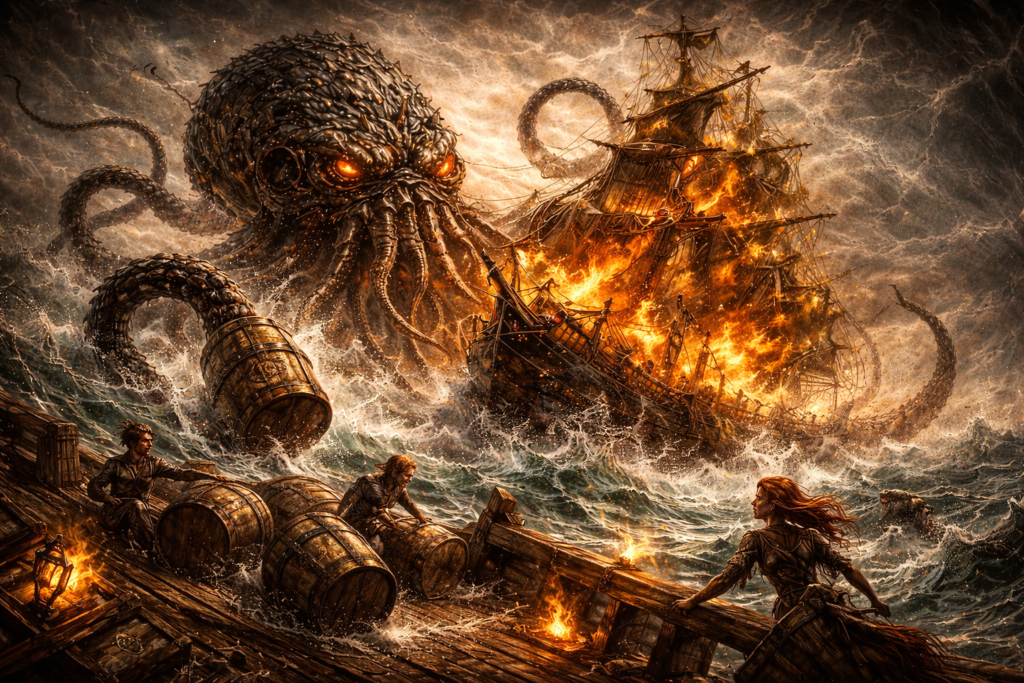
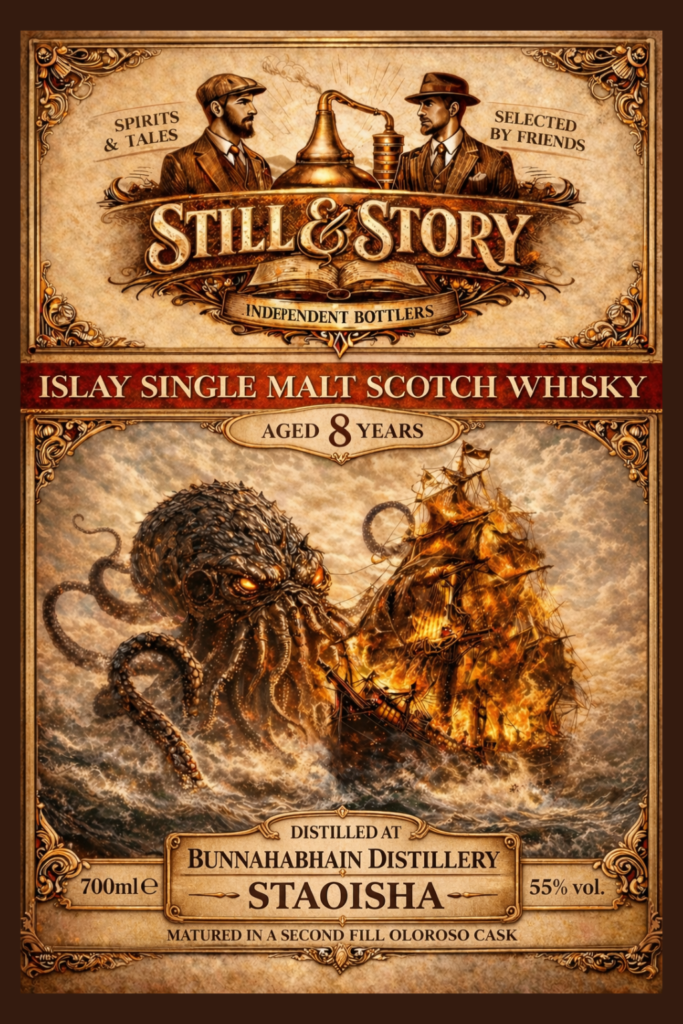
Our very first release is a monster of a dram! This 8 Year Old Bunnahabhain Staoisha “The Kraken” is a heavily peated islay single malt bottled at 55%, unchill-filtered and natural colour. Matured in second fill Oloroso Casks.
Be wary of your first sip, as you might find yourself captured by the kraken just like we did!
Listen to the audiobook here:
The Kraken Unleashed!
They called the ship The Covenant of Crows, though no prayer had ever truly lived aboard her.
She was a black-bellied galleon out of the western seas, broad in the beam and proud in the stern, built from storm-felled oak and bound with iron dark as old blood. Her figurehead was a blindfolded queen with a cup in her hand, and in the long years since her first launching, men had said she could smell gold through fog and trouble through calm water. She had crossed pirate currents and winter trenches, had outsailed privateers and outrun the fever winds of southern ports, yet none of those deeds made her famous. What made her name pass from tavern mouth to tavern mouth, from smuggler to monk to king’s assessor, was the cargo she bore on her final voyage.
Not silver.
Not spice.
Not relics lifted from forgotten chapels.
Whisky.
A hoard so rare that even the clerks who inked the manifests did so with trembling fingers. Casks from island warehouses where gulls nested in broken rafters. Barrels bought quietly from old families who sold land before they sold spirit. But at the heart of it all, lashed deep in the hold beneath chains and seals and a guard of armed men, were the dark, breathing casks from a northern isle where the sea chewed the cliffs and the peat banks smoked like sleeping altars. A fierce whisky, young in years and ancient in temper, married to a second-fill oloroso cask that had already learned how to keep secrets. Men said it smelled of stormfire and tasted like a tale told beside a dying hearth after battle. Men also said that no bottle from that parcel had been opened without changing the room around it.
The owner of the cargo was Lord Vale of Dunross, a collector whose thirst had long ago ceased to be human. He did not drink for pleasure, nor even for glory, but for possession. He wanted the rarest spirits lined beneath his keep not to share, but to know that no other hand could lift them. He travelled aboard The Covenant of Crows with six hired swords, a priest who had misplaced his faith, and a navigator named Elspeth Marr, who had once turned down an admiral’s seal because she preferred the honesty of rough water.
On the seventh night out, the sea began to listen.
Elspeth felt it before any man on deck spoke of it. The wind did not die, not exactly, but it narrowed, as though moving through unseen teeth. The waves lost their whitecaps and took on a slick, dark sheen like oil over iron. Above them, the moon hung behind gauze-thin cloud, and every rope, every spar, every nail in the hull seemed to hold its breath.
“Bad water,” muttered Tern, the old helmsman.
“There is no such thing,” said Lord Vale from beneath his sable cloak.
Tern did not turn. “That’s what landsmen say.”
In the hold below, the casks answered with soft wooden knocks, one against another, a language of slumber and warning. A labourer came up pale-faced and crossed himself.
“The barrels are shifting, captain.”
The captain, Rourke Sayer, spat into the sea. “Then wedge them tighter.”
“They’re not shifting with the ship, sir.”
No one liked the sound of that.
Still the voyage held on. Midnight rolled over the deck. Lanterns swayed. The priest, Father Corvin, stood at the stern and whispered some half-remembered litany to a God who had likely stopped watching sailors centuries ago. Lord Vale demanded mulled wine. Elspeth stood by the starboard rail and watched the black plain of water.
Then, from somewhere below, there rose a sound no man aboard had heard before and yet every soul recognized at once.
Not a whale’s cry.
Not timber strain.
Not thunder.
A vast, wet inhalation, as though the deep itself had scented them and found them worthy.
The sea burst.
A tentacle rose starboard side, taller than the mizzenmast, thick as a watchtower and armored in ridged suckers pale as old moons. It slammed onto the deck with a force that split planks and flung men like dolls. Another coiled over the forecastle. A third wrapped the mainmast and squeezed until the wood screamed sap and splinters into the night.
“Kraken!” someone howled, the word tearing out of him like a confession.
Then came the head.
It surfaced slowly, almost ceremoniously, as if some emperor of drowned kingdoms had chosen to rise and judge them. Its crown was a knotted mass of scars, barnacle-white and abyss-black, its eyes twin furnaces smouldering beneath a shelf of dripping flesh. Water sluiced from its beak in glittering ropes, and its many arms spread through the waves around the ship until the ocean itself seemed made of reaching limbs.
Men fired muskets. Harpoons flew. Steel struck hide and bounced away or lodged shallow as pins in a king’s hide cloak. The kraken barely seemed to notice. It did not rage in blind hunger. It moved with dreadful intention.
Elspeth saw it then: the beast was not attacking the crew. Not truly. It was searching.
A tentacle smashed through the hatch to the cargo hold.
Lord Vale went white. “Protect the barrels!”
No one moved fast enough.
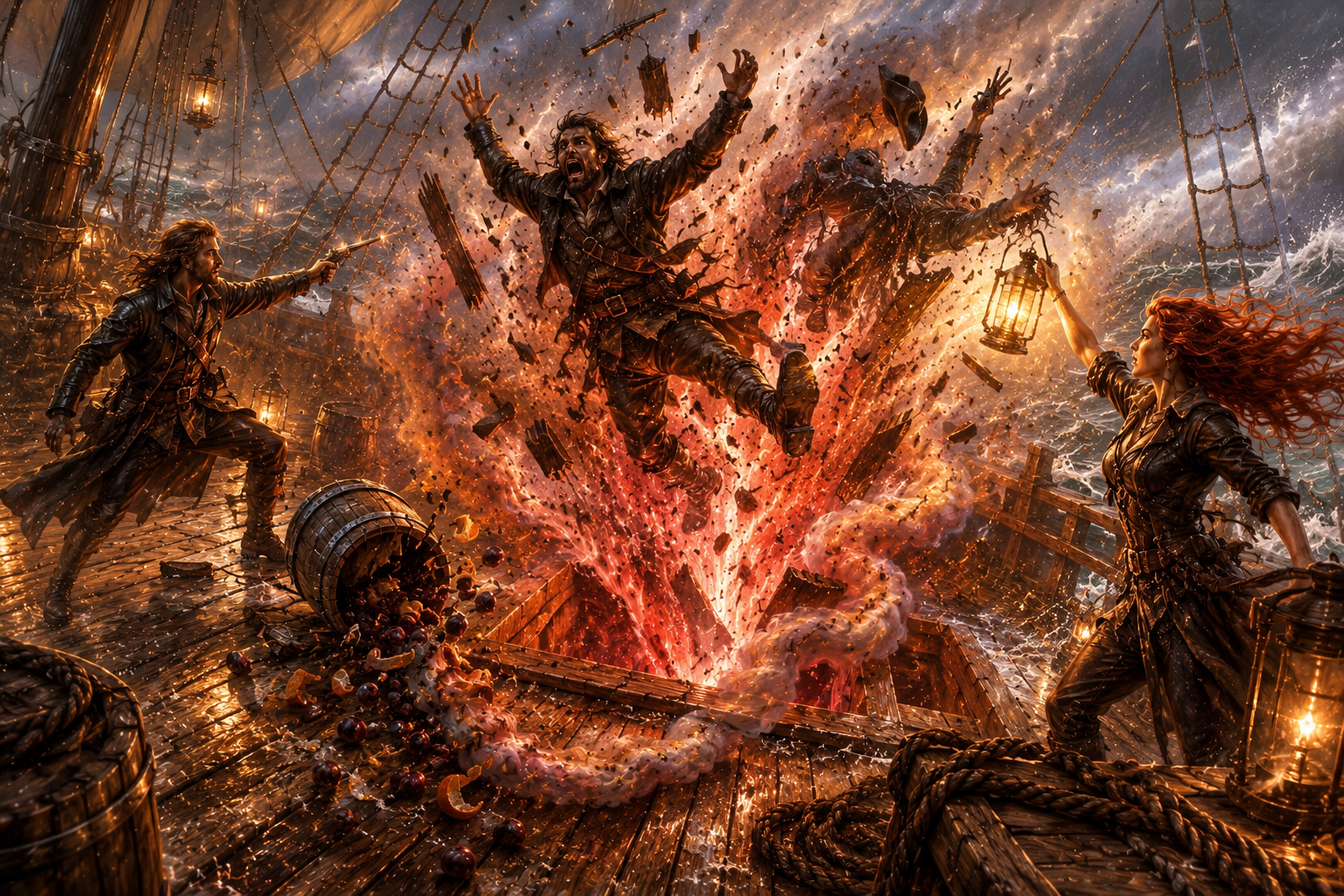
The hatch exploded upward. Two guards vanished screaming into the dark below. One moment they stood on oak boards with pistols drawn, the next they were gone, snatched into the red gloom of lantern-light and bursting staves. A smell climbed from the hold unlike anything the storm had carried so far: peat smoke, thick and earthy, the scent of wet embers roused from ancient moss; then dark fruit, dense and wine-rich, like raisins stewed in winter spice; then brine, tar, singed orange peel, black pepper, clove, and the leathery warmth of old wood opened at last.
The sea monster stilled.
All across its monstrous frame the tentacles tightened, then loosened, trembling almost delicately. One eye turned down toward the shattered hold. If beasts could remember, this one remembered. If monsters could desire, this one desired utterly.
Lord Vale saw it too, though he understood less. “Seal the hold! Seal it, damn you!”
“The beast wants the whisky,” Elspeth said.
He stared at her as though the truth were more blasphemous than the creature itself.
Below deck, casks were breaking open under the violence of the attack, and the spirit ran in amber ribbons through the bilge. It soaked the splintered wood. It flooded around boots and corpses and broken chains. Vapour climbed through the cracks with the heavy sweetness of sherry and the fiercer, medicinal strike of island peat, and every breath tasted of smoke and sea and fire-blackened fruit.
The kraken bent its terrible head toward the ruptured hatch and inhaled.
The entire ship lurched.
It was not greed alone in that motion. There was recognition in it, even reverence. Elspeth had heard old stories from kelp-farm widows and seal-hunters in black rock villages: stories of the First Distilling, when before men ever learned to char a cask or cut a peat sod, the deep things of the world taught the islands what patience meant. The sea gave salt. The bog gave smoke. Oak gave shelter. Time gave soul. And there were beasts below the waves, old before crowns, who guarded the fiercest spirits as dragons guarded gold.
She had thought those stories were made to dignify drunks.
Now she wondered whether all distilling lore was merely history remembered badly.
Another arm slammed across the deck, sweeping men into the sea. Captain Sayer hacked at it with a boarding axe until the limb flung him against the rail hard enough to fold him in half. The mainmast cracked. Sailcloth came down in a thunder of canvas. Lord Vale screamed for someone to save the cargo, but his voice had grown very small in the night.
Elspeth seized a lantern from its hook and descended into the hold.
It was madness, and perhaps because it was madness no one stopped her.
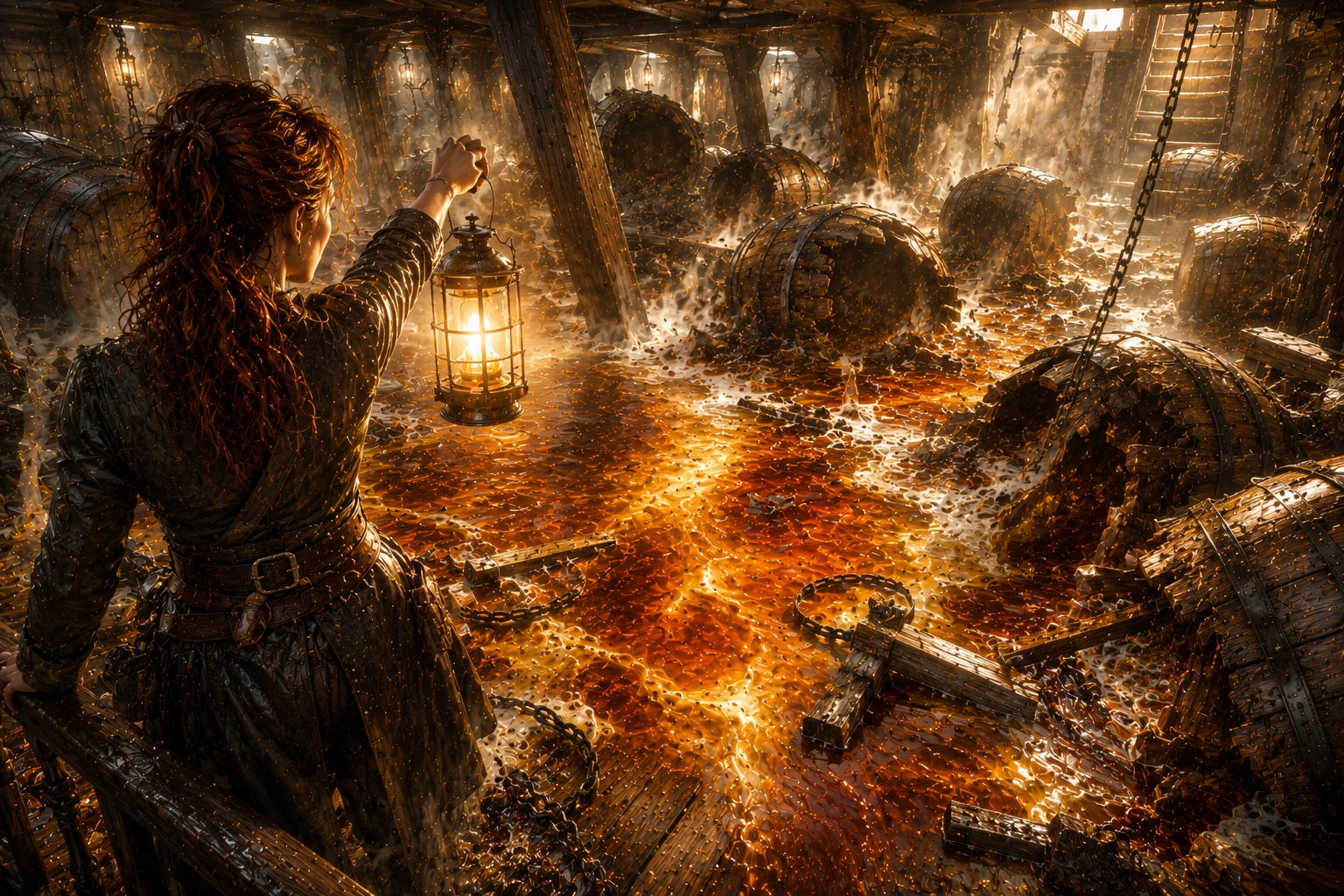
Below, the air was thick enough to drink. Spirit fumes burned her eyes. Broken casks lay like slain beasts, their iron hoops sprung, their fragrant blood washing between the beams. The whisky glittered in the lantern light, bronze and gold and copper-red where the oloroso influence deepened it, and the whole hold smelled like an island on fire at the edge of winter: chimney smoke, seaweed drying on black rock, treacle darkened in a pan, cracked pepper, damp earth, walnuts, old leather gloves, a flash of orange oil squeezed over flame, and beneath it all the medicinal, tarry pulse of peat that made the breath catch in her throat.
A section of hull had split inward, not enough to sink them yet, but enough to make a jagged mouth through which one of the kraken’s smaller arms quested. The suckers slid over cask heads and splintered timber, strangely gentle, as if reading by touch.
Elspeth lifted the lantern higher.
The arm froze.
There, in that ruptured hold reeking of spirit, she saw something impossible. Bound around the base of the tentacle was a chain of iron-black stones, each carved with the same mark burned into the lead seals on the rarest casks: a spiral like a whirlpool crossed by a blade of barley.
“You know this whisky,” she whispered.
The tentacle moved again, not striking, only waiting.
Behind her, boots pounded on the ladder. Lord Vale descended with pistol in hand, his face raw with terror and rage. “Get away from it.”
“It hasn’t killed me.”
“It will.”
“No,” she said, hearing the certainty in her own voice, “it came for this.”
Lord Vale looked at the ruptured casks, and greed overcame even fear. “Then it dies for it.”
He raised the pistol and fired.
The shot rang like sacrilege.
The ball struck the creature just above a sucker. Black fluid hissed onto the timbers, and in that same instant the ship convulsed under a scream from above so vast it seemed to tear the cloudbank open. The arm in the hold whipped forward, not at Elspeth, but at Vale. It wrapped him from chest to ankle, crushing the pistol from his hand. He shrieked as ribs snapped like kindling.
“No!” Elspeth shouted, though she did not know whether she spoke for the man or the ship.
The tentacle dragged Lord Vale toward the breach. His fingers clawed the wet boards. His boots slipped in whisky. He caught hold of an intact cask, one of the precious eight-year island barrels, sealed and marked. For one desperate second man and monster contended over it.
Then the cask split its cradle and went with him.
The breach widened. Sea poured in. The arm, with its screaming prize and the barrel clutched against him, vanished back into the dark.
Above, the battle changed.
The kraken no longer struck wildly. Its arms closed around the ship with the grim assurance of conquest. Masts toppled. The stern lifted. Men leapt overboard rather than be dragged under with snapping timbers. Father Corvin stood on the listing deck and began laughing like a lunatic at last proven right about something. Captain Sayer bellowed for boats that were already smashed. Tern, still at the helm though the helm no longer mattered, whispered an old sailor’s apology to the sea.
Elspeth climbed back into the storm of ruin and found the great beast towering over them, one immense arm curled protectively around the stolen cask even as flames licked up the fallen rigging. For in the chaos a lantern had broken, and spilled spirit had caught. Fire now ran golden across the deck, fed by whisky vapor, beautiful and ravenous.
The kraken watched it.
In its burning eyes she saw no animal stupidity. She saw memory older than empire. She saw a guardian robbed for too long.
The priest stumbled to her side, soot-black and bleeding. “Is this judgement?”
“It might be theft answered.”
He barked a laugh, half cough. “That sounds more likely.”
The sea boiled as another broken cask rolled free and burst near the rail. The smell rose hotter now, richer: smoked malt and charred oak, figs and dates, bitter chocolate, iodine, cracked pepper, salt spray, singed herbs, and something wild beneath it all, like a campfire built on a storm beach from driftwood and old ropes. Men who had been fighting stopped, just for a heartbeat, and breathed it in with faces gone slack. Even in terror they knew splendour when it filled the air.
The kraken moved toward the shattered cargo hatch again.
“It wants the rest,” Elspeth said.
Captain Sayer, blood down his temple, stared at her as if she were mad. “Then let it choke.”
“No. Listen to me.” She pointed to the deck, to the dead, to the fire running along spilled spirit. “We cannot save ship or cargo. But perhaps we can save ourselves.”
“What are you saying?”
She looked at the hold, at the casks chained there by a greedy lord now gone into the deep. “Give it what it came for.”
No one agreed quickly. Men are seldom noble when the cost is real. Yet the sea was already making the choice for them. Water flooded the lower deck. The mainmast had taken the rigging with it. The longboats were splinters. The only bargain left was with the monster at their rail.
So they broke the seals.
One by one, with axes and iron bars, they rolled the finest casks to the ruined edge of the deck and sent them down. Each barrel struck the water with a hollow boom and vanished among the writhing arms. With each offering the kraken grew calmer, less like a storm and more like a sovereign receiving tribute long denied. It gathered the casks not in frenzy, but with uncanny care.
When the last of the marked barrels went over, the beast lingered.
Its enormous eye fixed on Elspeth.
She stood alone at the rail now. Around her the survivors huddled amid smoke and ruin, not speaking. Her hair whipped in the salt wind. Ash and mist clung to her face. She did not bow, because some things greater than kings do not want bowing. She only met that furnace gaze and said, softly, “It should have been shared.”
The kraken regarded her. Then, from the water below, one arm rose and laid upon the rail an object slick with brine.
A bottle.
Dark glass, long-necked, sealed in black wax, no label upon it but the spiral mark crossed by barley. Inside, the liquid glowed ember-red in the firelight.
The arm withdrew.
Then the sea emperor descended.
Its vast head sank beneath the waves. The tentacles unwound from the wreck. The black water closed over scars, suckers, and watching eyes. One by one the captured casks disappeared into the deep after it, as if the ocean itself had opened cellars beneath the world. The flames on deck hissed lower in the salt spray. Dawn, still far off, sent a paling thread along the eastern horizon.
The Covenant of Crows did not sink that night, though perhaps sinking would have been cleaner. She drifted, broken-backed and half-burned, until a fishing vessel found the survivors two days later clinging to ruin and silence. Captain Sayer never sailed again. Father Corvin returned to his chapel and preached strange sermons about appetite, stewardship, and the holiness of smoke. Tern died within the year and was buried with a dram poured over the soil. As for Lord Vale, no body was ever recovered. Some said he was dragged into a palace of shipbones beneath the trench, there to watch forever as the bottles he hoarded were finally opened for worthier hands.
Elspeth kept the bottle.
Not because she believed it was payment. Gifts from the deep are never payment. They are remembrance.
Years passed before she broke the wax.
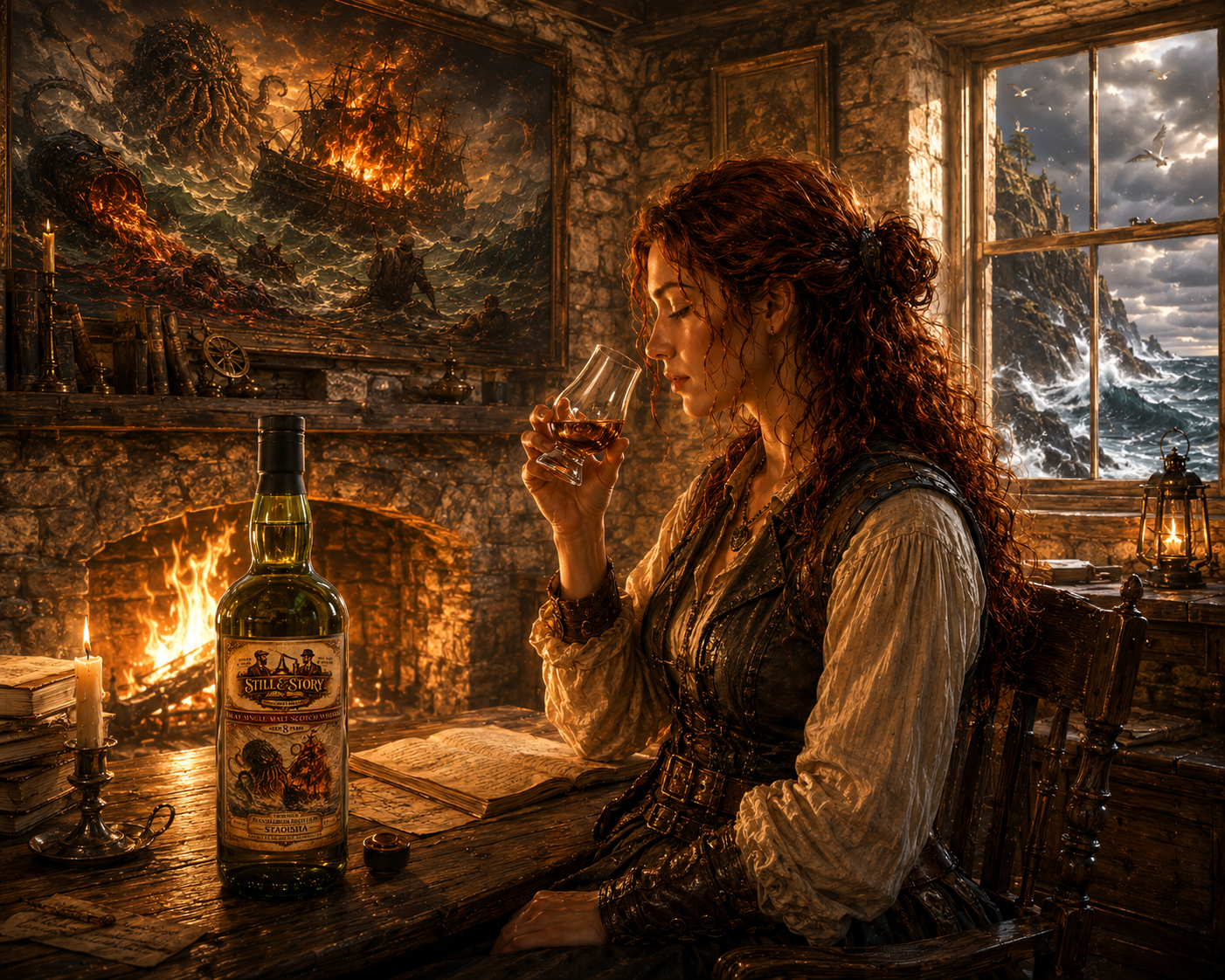
She did so on an autumn evening in a stone house above a northern shore while outside the tide slammed the cliffs and gulls cried into the dark. She poured only one measure. The aroma rose at once and filled the room so completely it seemed to paint the walls in amber shadow.
First came peat smoke, dense and noble, like old fires lit in caves by people who knew the sea could take them any night. Then a rush of salted air and kelp and iodine, the very breath of surf striking black rock. Beneath that unfolded the richer heart of it: oloroso darkness, dried figs, raisins, walnut oil, burnt orange peel, clove, leather satchels, bitter chocolate, treacle, toasted oak. There was black pepper too, and char, and a curious note like smouldering rope on a harbour wall after rain.
She drank.
The whisky arrived not as liquid, but as weather. A wave of smoke rolled first, then sweetness deep as red fruit stewed in iron pots, then brine and spice and a fierce warmth like walking too near a bonfire built from shattered casks. The texture was oily and commanding, yet alive with sparks. The finish held forever, all embers and sea salt and sherry-dark fruit, with that lingering medicinal edge of true island peat singing underneath like a blade.
As she sat with the glass, the room changed. Not by magic, perhaps, but by memory given form. She could hear the crashing sea again, see the burning ship, feel the awful majesty of that rising head in the night. And she understood at last what the old stories had meant.
The greatest spirits are never merely made.
They are contested.
Won from bog, wind, oak, salt, patience, and flame.
They belong, for a little while, to human hands, but never entirely. Somewhere in every true island dram there remains a claim older than commerce, something wild and tidal and half-monstrous, as though the sea itself wishes to taste what men have made from its weather.
Elspeth lifted the last of the pour toward the dark window, where beyond the glass the horizon lay unseen and immense.
“To the conqueror,” she said.
Far below, between the hammering of the waves, she thought she heard an answer: a low, vast sound like a creature breathing in smoke, salt, oak, and fire, and keeping the memory of them forever in the deeps.
Prachtige site mannen! Hoop informatie.
Ik ga ervan uit dat jullie ook Nederlands publiek willen bereiken. Mijn advies is om ook de site in het Nederlands te vertalen. Ook het luisterboek. En pas je prompt wel iets aan zodat de stem zijn intonatie aanpast op de context.
Dankjewel Dennis, en bedankt voor het meedenken! We hebben zeker de wens om Still & Story in de toekomst ook in het Nederlands aan te bieden, zowel de site als de audio. Zodra dit met onze releases haalbaar is, gaan we daar zeker mee aan de slag!